Romeo and Juliet Law – A Powerful Guide to Understanding Close-in-Age Legal Protection
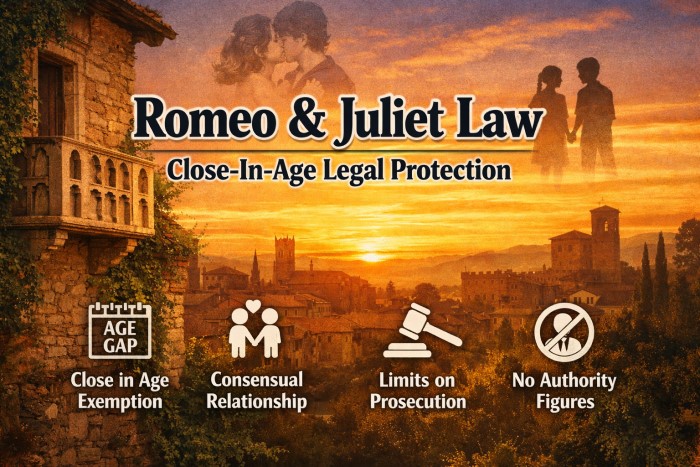
Table of Contents
ToggleIntroduction: What the Romeo and Juliet Law Really Means
The romeo and juliet law is a legal concept that often creates confusion, debate, and misunderstanding. Many people hear the name and assume it legalizes underage relationships, while others believe it offers blanket protection to young couples. In reality, the romeo and juliet law is far more limited and carefully defined.
This law exists to address situations where two young people, close in age, engage in a consensual relationship but fall on different sides of age-of-consent laws. Instead of imposing the harshest criminal penalties, the law provides limited relief in specific circumstances. Understanding how this law works is essential for students, parents, and anyone researching age-of-consent rules.
What Is the Romeo and Juliet Law?
Definition and Legal Concept
The romeo and juliet law refers to close-in-age legal provisions found in certain jurisdictions, particularly within the United States. These provisions create exceptions or reduced penalties under statutory rape laws when both individuals are relatively close in age and the relationship is consensual.
When people ask what is the romeo and juliet law, the simplest answer is this: it is not a single nationwide rule, but a legal principle applied differently depending on local statutes.
Why the Law Exists
Strict age-of-consent laws are designed to protect minors from exploitation. However, lawmakers recognized that applying these laws without exceptions could result in disproportionate punishment for young people involved in age-appropriate relationships. The law of romeo and juliet exists to balance protection with fairness.
Historical Background of the Law
Origin of the Name
The name comes from the famous literary work Romeo and Juliet, written by William Shakespeare. The story centers on two young lovers of similar age, which symbolically reflects the idea behind these legal protections.
Development in Modern Law
The law romeo and juliet concept emerged as lawmakers reviewed cases where teenagers faced severe legal consequences despite mutual consent. Over time, some jurisdictions added close-in-age provisions to prevent lifelong criminal labeling.
How Romeo and Juliet Laws Work
Close-in-Age Requirement
Most romeo and juliet laws focus on age proximity. The individuals involved must be close in age, as defined by the statute. The acceptable age gap is set by law and varies by jurisdiction.
Consent Is Mandatory
Consent is central to the law of romeo and juliet. If consent is absent, unclear, or compromised, the protection does not apply. The law never excuses coercion, manipulation, or abuse.
Limited Legal Relief
Romeo and juliet laws do not always eliminate criminal liability. Instead, they may reduce charges or limit penalties. In some cases, they affect sentencing or registration requirements rather than prosecution itself.
What Romeo and Juliet Laws Do Not Do
No Blanket Legalization
The romeo and juliet law does not legalize sexual activity with minors in general. It only applies under narrow conditions explicitly defined in law.
No Protection for Exploitation
Any relationship involving exploitation, authority, or imbalance of power is excluded. Teachers, guardians, or individuals in positions of trust are not protected under these laws.
No Universal Application
There is no single standard version of the law romeo and juliet. Each jurisdiction decides whether to adopt such provisions and how to enforce them.
Legal Scope and Jurisdictional Limits
State-Level Application
Romeo and juliet laws are applied at the state or local level. Courts interpret them strictly according to statutory language, and eligibility depends entirely on how the law is written.
Judicial Interpretation
Judges do not assume protection automatically. Each case is examined based on age, consent, and statutory criteria. This makes legal outcomes highly fact-specific.
Public Policy and Legal Debate
Supporters’ Perspective
Supporters of romeo and juliet laws argue that they prevent unnecessary harm to young people’s futures. They believe the law reflects social reality and avoids lifelong penalties for youthful mistakes.
Critics’ Perspective
Critics argue that the laws vary too widely and can be misunderstood. Some believe clearer age-of-consent rules would be more effective than exceptions.
Despite debate, romeo and juliet laws remain an established part of modern criminal justice discussions.
Related Keywords Explained
Law of Romeo and Juliet
The law of romeo and juliet refers broadly to the legal principle behind close-in-age exemptions, not a single statute.
Law Romeo and Juliet
This phrase is often used informally to describe state-level exceptions within statutory rape laws.
Romeo and Juliet Laws
The plural form highlights that multiple jurisdictions have different versions of these provisions.
What Is the Romeo and Juliet Law
This question usually reflects public interest in how age-of-consent rules apply to teenage relationships.
Quick Info About Romeo and Juliet Law
Key Facts at a Glance
-
It is a legal exception, not a universal rule
-
It applies only in specific jurisdictions
-
Consent is always required
-
Age proximity is essential
-
Abuse or authority removes protection
FAQs About Romeo and Juliet Law
Is the Romeo and Juliet Law the Same Everywhere?
No. Romeo and juliet laws vary widely depending on jurisdiction. Each area defines its own criteria.
Does the Law Make Underage Relationships Legal?
No. The law provides limited relief in specific cases but does not broadly legalize underage sexual activity.
Can Adults Use This Law as a Defense?
Only if the law explicitly allows it and all conditions are met. Most statutes are narrow and strictly applied.
Does the Law Protect Against All Penalties?
Not always. Some laws reduce penalties rather than eliminate them entirely.
Is the Romeo and Juliet Law Automatic?
No. Courts examine each case individually. Protection is never assumed.
Conclusion: Why Understanding the Romeo and Juliet Law Matters
The romeo and juliet law plays an important role in modern legal systems by distinguishing between exploitation and age-appropriate consensual relationships. It exists to ensure fairness without weakening protections for minors. However, because the law is limited and jurisdiction-specific, misunderstanding it can lead to serious consequences.
Anyone researching the law romeo and juliet concept should remember that it is not a loophole or permission, but a narrowly defined legal safeguard. Understanding its scope, limits, and purpose is essential for responsible awareness and informed discussion.