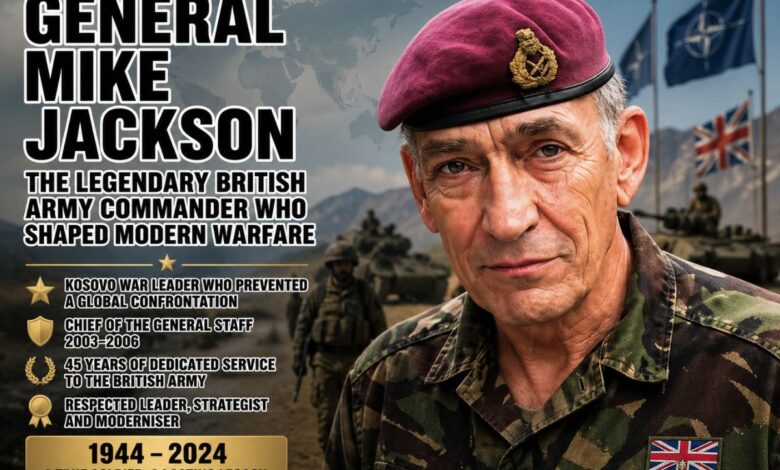
General Mike Jackson: The Legendary British Army Commander Who Shaped Modern Warfare
Introduction
General Sir Mike Jackson was one of the most influential and respected British Army officers of the modern era. With a military career spanning more than four decades, he rose to the highest position in the British Army and played a key role in shaping NATO operations in Europe and British military strategy in the early 21st century.
Known for his calm leadership, sharp judgment, and moral courage, Jackson became especially famous during the Kosovo War, where he made a decision that prevented a potential international escalation. His leadership during the Iraq War and his reforms as Chief of the General Staff further cemented his reputation as a thoughtful and decisive military figure.
Early Life and Military Beginnings
Childhood and Education
General Mike Jackson was born in 1944 in Sheffield, England. He grew up in a post-war Britain where military service was highly respected. From an early age, he showed discipline, leadership qualities, and an interest in national service.
Joining the British Army
In 1963, Jackson was commissioned into the British Army. He joined the elite Parachute Regiment, one of the most demanding infantry units in the British Armed Forces. This marked the beginning of a long and distinguished military journey.
Rise Through the Ranks
Early Service
During his early career, Jackson served in several operational environments, gaining experience in conflict zones and peacekeeping missions. He built a reputation for professionalism, calmness under pressure, and strong leadership.
Northern Ireland and Bosnia
He served during The Troubles in Northern Ireland, where British forces faced complex urban warfare and political tensions. Later, he was involved in peacekeeping operations in Bosnia during the Yugoslav conflicts, where NATO forces worked to stabilize the region.
These experiences shaped his strategic thinking and deep understanding of modern conflict.
Kosovo War – Defining Moment of Leadership
NATO Command Role
One of the most defining chapters of Jackson’s career came in 1999 during the Kosovo War. He was appointed as the commander of NATO’s Kosovo Force (KFOR), responsible for stabilizing the region after intense conflict.
The Famous Decision
During the deployment of international forces, a tense situation developed when Russian troops unexpectedly moved to secure Pristina airport before NATO forces arrived.
A U.S. general reportedly suggested blocking them. Jackson refused, stating he would not escalate the situation into a potential global crisis.
His response—widely remembered as a defining moment—reflected his belief in measured action over aggressive escalation.
Impact of His Decision
- Prevented direct NATO-Russia military confrontation
- Maintained fragile peace negotiations
- Demonstrated strategic restraint in high-pressure conditions
This moment made him internationally recognized as a commander who prioritized global stability over confrontation.
Chief of the General Staff (2003–2006)
Appointment to Top Position
In 2003, Mike Jackson became Chief of the General Staff, the professional head of the British Army. This was the highest position in the British military structure.
Iraq War Leadership
During his tenure, British forces were actively involved in the Iraq War. Jackson oversaw operational strategy, troop deployment, and military coordination with international allies.
Army Modernization
He also led major reforms, including:
- Restructuring of infantry regiments
- Modernization of equipment and tactics
- Improved focus on rapid deployment forces
These changes aimed to prepare the British Army for 21st-century warfare.
Leadership Style and Personality
Calm Under Pressure
Jackson was widely admired for his calm, analytical approach. Even in highly tense situations, he avoided emotional decision-making.
Soldier-Focused Leadership
He had a strong connection with the troops under his command. Many described him as approachable, fair, and deeply committed to soldier welfare.
Direct Communication
His communication style was simple and direct, which made him effective in both military and political environments.
Retirement and Later Life
After retiring in 2006, Jackson remained active in public discussions on defense and international security. He wrote and spoke about military strategy, leadership, and global conflict management.
He was often invited to comment on NATO operations and modern warfare challenges, where his insights were highly respected.
Death and Legacy
General Sir Mike Jackson passed away in October 2024 after a long illness. His death marked the end of an era in British military leadership.
Lasting Legacy
His legacy includes:
- Preventing escalation during the Kosovo conflict
- Leading the British Army through the Iraq War period
- Modernizing the British Army structure
- Setting an example of disciplined, ethical military leadership
He is remembered as a leader who combined strength with restraint.
Quick Info About General Mike Jackson
- Full Name: Sir Michael David Jackson
- Born: 1944, Sheffield, England
- Died: October 2024
- Service Years: 1963–2006
- Highest Rank: General
- Top Position: Chief of the General Staff
- Known For: Kosovo War leadership, Iraq War command, Army modernization
- Unit: Parachute Regiment
FAQs About General Mike Jackson
Who was General Mike Jackson?
He was a senior British Army officer who served as Chief of the General Staff and played major roles in Kosovo and Iraq military operations.
What is he most famous for?
He is best known for his leadership during the Kosovo War, where he prevented a potential NATO-Russia confrontation.
What rank did he achieve?
He achieved the rank of General and became the professional head of the British Army.
When did he retire?
He retired from active military service in 2006 after more than 40 years of service.
Why is he respected in military history?
He is respected for his strategic thinking, calm decision-making, and ability to balance military force with political sensitivity.
Conclusion
General Mike Jackson remains a significant figure in modern military history. His leadership style, defined by restraint, intelligence, and responsibility, set him apart from many of his contemporaries. From the battlefields of Bosnia to the tense standoff in Kosovo and the strategic challenges of Iraq, his career reflects the evolution of modern warfare and military diplomacy.